Most people in Richmond have eaten tandoori chicken. Far fewer know what made it taste that way — or why no skillet, broiler, or backyard grill can quite replicate it. The answer lives inside a 5,000-year-old clay pot, still burning in kitchens across South Asia and, right here in Richmond, inside Bajra Indian Bistro.
If you have ever wondered why your favorite restaurant’s tandoori dishes carry a smoky depth that no homemade marinade seems to nail, this post is for you. We are going to break down exactly what a tandoor is, the science behind what it does to food, and why it produces flavors that simply cannot be faked.
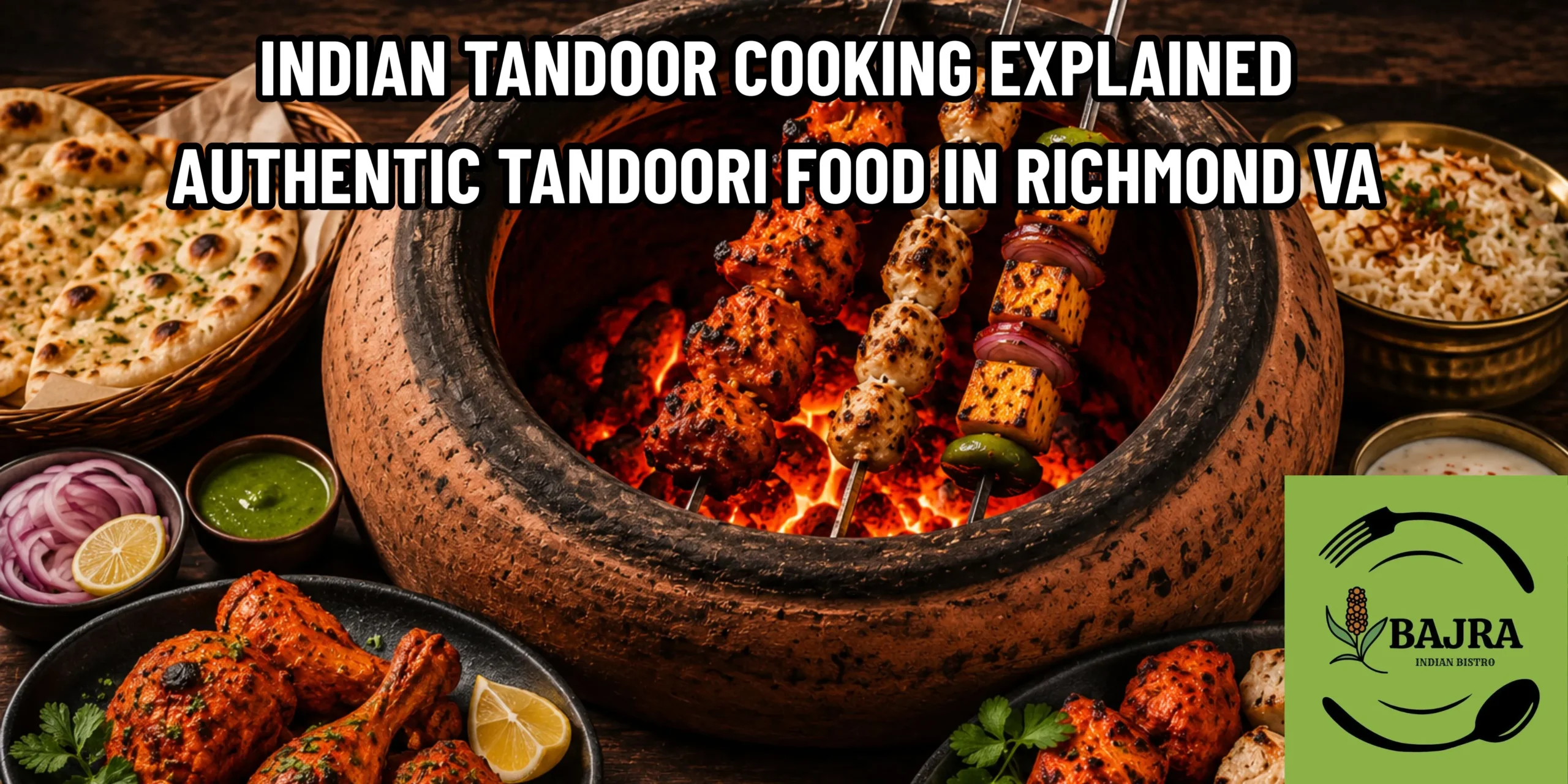
A tandoor is a cylindrical clay oven, typically shaped like a large urn, that stands about four feet tall and is fired by charcoal or wood at its base. The walls of the oven are made of clay — sometimes reinforced with sand, salt, or horsehair — and the whole vessel is often set into the ground or embedded in a masonry base to retain heat.
The fire burns at the bottom. Food is either skewered on long metal rods and lowered into the oven from the open top, or slapped directly onto the interior clay walls — as with naan and roti breads. There is no pan, no water bath, no foil. Just direct heat, radiant heat from glowing clay walls, and live fire.
Temperatures inside a properly fired tandoor routinely reach 480 to 500°C (900°F) — nearly twice the maximum temperature of a conventional home oven. That extreme heat is the first reason everything that comes out of a tandoor tastes different.
When protein hits that 900°F heat, the outside chars in seconds. This is not burning — it is the Maillard reaction on overdrive, the same chemical process that makes seared steak taste better than boiled steak, but happening far faster and more intensely. The crust locks in moisture before it can escape, leaving the interior of a chicken thigh or a leg of lamb incredibly juicy while the exterior has genuine smoky char.
A grill can approach this, but grills cook from below. A tandoor surrounds the food with radiant heat on all sides simultaneously. The cook time for a marinated chicken piece is often just 8 to 12 minutes — far too fast for the interior to dry out.
As fat and marinade drip from the skewered meat toward the coals below, they vaporize and create bursts of aromatic smoke that rise back up and coat the food. This is called dhuan in South Asian cooking — it is not incidental smoke, it is a flavor delivery mechanism. The tandoor is essentially recycling the food’s own drippings back onto it as aromatic smoke.
You cannot replicate this with a gas grill or an oven. The closed cylindrical shape of the tandoor traps and concentrates this smoke around the food in a way an open grill never can.
This surprises most people. The porous, unglazed clay walls of a seasoned tandoor absorb fat, spice oils, and smoke over years of use. When the oven fires up, that absorbed history radiates back into the food. A tandoor that has been cooking for five years contributes a subtly different flavor than a brand-new one — in the same way a well-seasoned cast-iron pan has flavors a new one never will.
It is also why naan that has been slapped directly onto a clay wall tastes nothing like naan baked on a metal sheet. The bread picks up a faint earthiness, micro-char, and a chew that is entirely unique to contact with fired clay.
This question comes up constantly, so let us settle it directly.
| Tandoori Chicken | Grilled Chicken | |
|---|---|---|
| Heat Source | Radiant clay walls + live charcoal | Direct flame or metal grate from below |
| Temperature | Up to 900°F | 350–550°F typical |
| Cook Time | 8–12 minutes | 20–30 minutes |
| Smoke Profile | Trapped, recycled dripping smoke | Open, dissipating smoke |
| Marinade Depth | Yogurt-spice base penetrates deeply | Surface-level or basted |
| Result | Juicy interior, blistered exterior, complex smoke | Good char, lighter smoke, less depth |
Neither is objectively better — but they are entirely different products. Grilled chicken is a technique. Tandoori chicken is an experience.
Most tandoori proteins are marinated for hours — often overnight — in a blend of full-fat yogurt, ginger-garlic paste, and a mixture of spices that typically includes cumin, coriander, garam masala, Kashmiri chili (for color and mild heat), and turmeric.
The yogurt serves two functions. First, its lactic acid partially denatures the proteins in the meat, opening up the muscle fibers so spices can penetrate deeply rather than just sitting on the surface. Second, the yogurt coating chars on the outside of the tandoor before the meat overcooks, creating a thin, spiced crust that seals in juices. Without yogurt, the extreme heat of the tandoor would simply scorch the meat dry.
Chicken gets all the attention, but a working tandoor is a versatile tool. Here is what comes out of one beyond the obvious:
At Bajra, the Tandoor Specialties section of the menu brings this full range together. The Tandoori Combo is the best way to experience the breadth of what the oven can do in a single order — it lets you taste how the same fire, the same clay, the same smoke creates completely different results depending on what goes in.
Not every Indian restaurant uses an actual tandoor. Some simulate tandoori flavor with broilers, conventional ovens, or stovetop char — which can produce passable results but never the combination of wood smoke, clay, and trapped-dripping flavor that defines the real thing.
The way to tell: genuine tandoori dishes have an uneven, almost random char pattern — some spots darker than others, some puffed, some slightly flattened where the skewer pressed. The skin or outer crust has a slightly papery, blistered texture that no broiler can replicate. The smoke flavor is present but not aggressive — it is woven into the meat rather than sitting on top of it.
This is a fair question. The char and crust will soften slightly in transit — that is physics, and there is no avoiding it. But the deeper flavor payoff of tandoor cooking — the smoke absorbed into the meat, the spice penetration from the overnight marinade, the juicy interior — all of that survives delivery extremely well. In fact, many people find that a 15-minute rest inside a container lets the juices redistribute in a way that makes the first bite even better than it would be at the pass.
The same is true for naan ordered with your meal. It softens in transit but retains its clay-kissed flavor and the slight char better than any oven-baked alternative would.
If you have never ordered from Bajra’s Tandoor Specialties section, the Tandoori Combo is the recommended starting point — it is built specifically to showcase what the oven does across multiple proteins and preparations in a single order.
Richmond delivery and pickup orders are available directly through our online ordering page. No third-party fees, no extra steps.
Order Tandoori Dishes for Delivery or Pickup →
Or visit bajraindianbistro.com to learn more about the restaurant, view our full menu, and find us in Richmond.
Bajra Indian Bistro is Richmond VA’s authentic tandoori and North Indian cuisine destination, serving dine-in, takeout, and delivery with traditional clay oven cooking.